
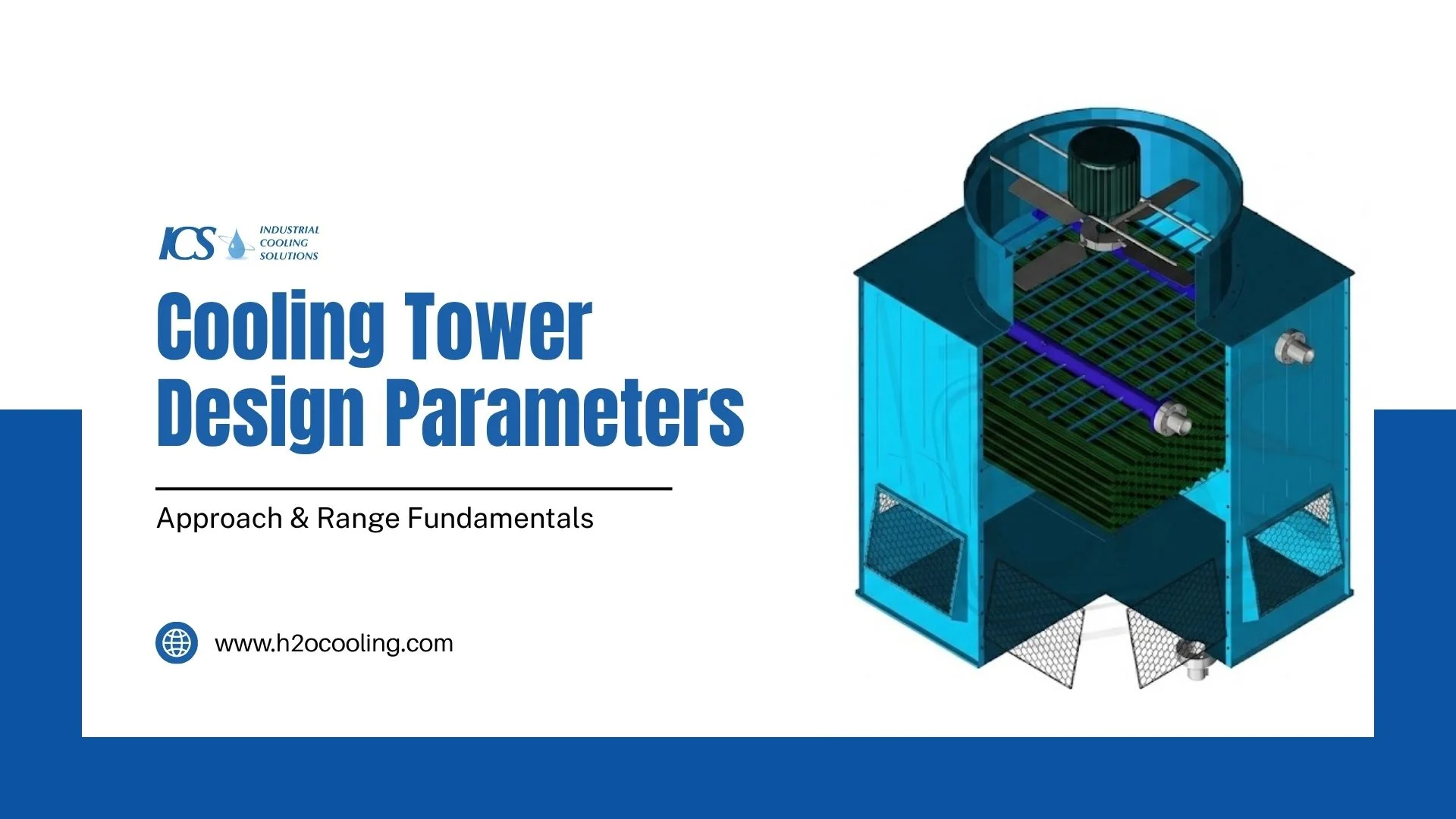
Cooling Tower Design Parameters: Approach & Range Fundamentals
By Tim Bozic. Published 2026-02-13 09:18:18. Last updated 2026-08-13 12:10:21.
This guide defines each one, gives the formula that links them, and shows how the choices trade against each other.
Cooling tower design parameters are the approach, range, and design wet-bulb temperature that together set a tower's size, energy draw, and lifecycle cost. Range tells you how many degrees the tower must remove per pass.
Approach tells you how close the tower gets to the wet-bulb limit. A tighter tower approach temperature buys colder outlet water temperature at the cost of a larger, pricier unit. Get these three numbers right before you ever call a vendor.
Cooling Tower Design Parameter Definitions
To effectively size and select a cooling tower, one must first master the specific terminology used in the industry. The two most critical cooling tower design parameters are "range" and "approach," which together define the thermal duty the tower must perform.

Range
The range represents the temperature difference between the hot water entering the cooling tower and the cold water leaving it. It indicates exactly how much heat the tower rejects from the water during a single pass through the fill media.
To calculate the range, you simply subtract the cold water outlet temperature from the hot water inlet temperature:
Range = Temperature (Hot Water Inlet) − Temperature (Cold Water Outlet)
In many standard applications, the range typically falls between 10°F and 15°F (5.5°C to 8.3°C). However, industrial processes may require a significantly higher range depending on the heat load. The range is determined strictly by the process heat load and the water flow rate, not by the tower's capability.
Approach
Approach is the gap between the outlet water temperature leaving the tower and the ambient wet-bulb temperature of the entering air, showing how close the tower comes to the theoretical cooling limit.
The formula for the approach is:
Approach = Temperature (Cold Water Outlet) − Wet-Bulb Temperature
A lower approach means the cold water temperature is closer to the wet-bulb temperature, which indicates higher thermal performance. However, achieving a lower approach requires a larger, more expensive tower. Standard design approach values often range from 5°F to 7°F (2.8°C to 3.9°C) for industrial applications, while HVAC applications might see slightly higher values.
The Relationship Between Approach and Range
Understanding how these two variables interact is essential for balancing system efficiency with capital cost. The approach and range relationship dictates the physical size of the tower and its ability to reject heat under varying atmospheric conditions.
Cooling tower efficiency is mathematically defined by the interaction of these two parameters using the following formula:
Efficiency = (Range / (Range + Approach)) × 100
When the approach decreases while the range remains constant, the thermal efficiency of the tower increases. However, the law of diminishing returns applies here; as the approach approaches zero, the required tower size grows asymptotically.
A specific "cooling tower design parameter" set must balance the need for cold water against the exponential increase in fan power and surface area required to achieve it.
Thermal Design Basics
Successful cooling tower selection relies on accurate data regarding heat loads and environmental conditions . Ignoring thermal design basics can lead to undersized units that fail to cool the process water on hot days or oversized units that waste capital and energy.
Heat Load and Cooling Requirements
The heat load is the amount of heat energy the tower must remove from the system per unit of time. This value is a fixed requirement of the process or chiller that the tower serves and is calculated using the mass flow rate, specific heat of water, and temperature differential.
Q = m × Cp × ΔT
Getting the design point right is not optional. If cooling tower design parameters do not account for peak cooling load, the process fluid returns hotter than downstream equipment can handle, which can trip the system or cut production capacity.
Ambient Wet Bulb Considerations
The ambient wet-bulb temperature acts as the absolute thermal floor for evaporative cooling. No matter how large or efficient the cooling tower is, it cannot cool water to a temperature lower than the entering air's wet-bulb temperature.
Designers should choose a wet-bulb temperature that accurately reflects the local climate, typically using ASHRAE weather data.
Selecting a value too low may lead to a tower unable to meet demand during summer peaks.
Choosing a value too high can lead to unnecessary capital costs.
Impact on Tower Performance
The interaction between design wet bulb, range, and approach shapes actual field performance, which is why manufacturers publish tower performance curves for each model and flow rate. These curves plot how cold water temperature shifts as ambient wet bulb changes, confirming a tower will hold its design approach across a real weather range, not just at one design point.
A tower built for a tight 5°F approach holds colder water and improves chiller efficiency, but it costs more and takes up more space than one built for a 10°F approach.
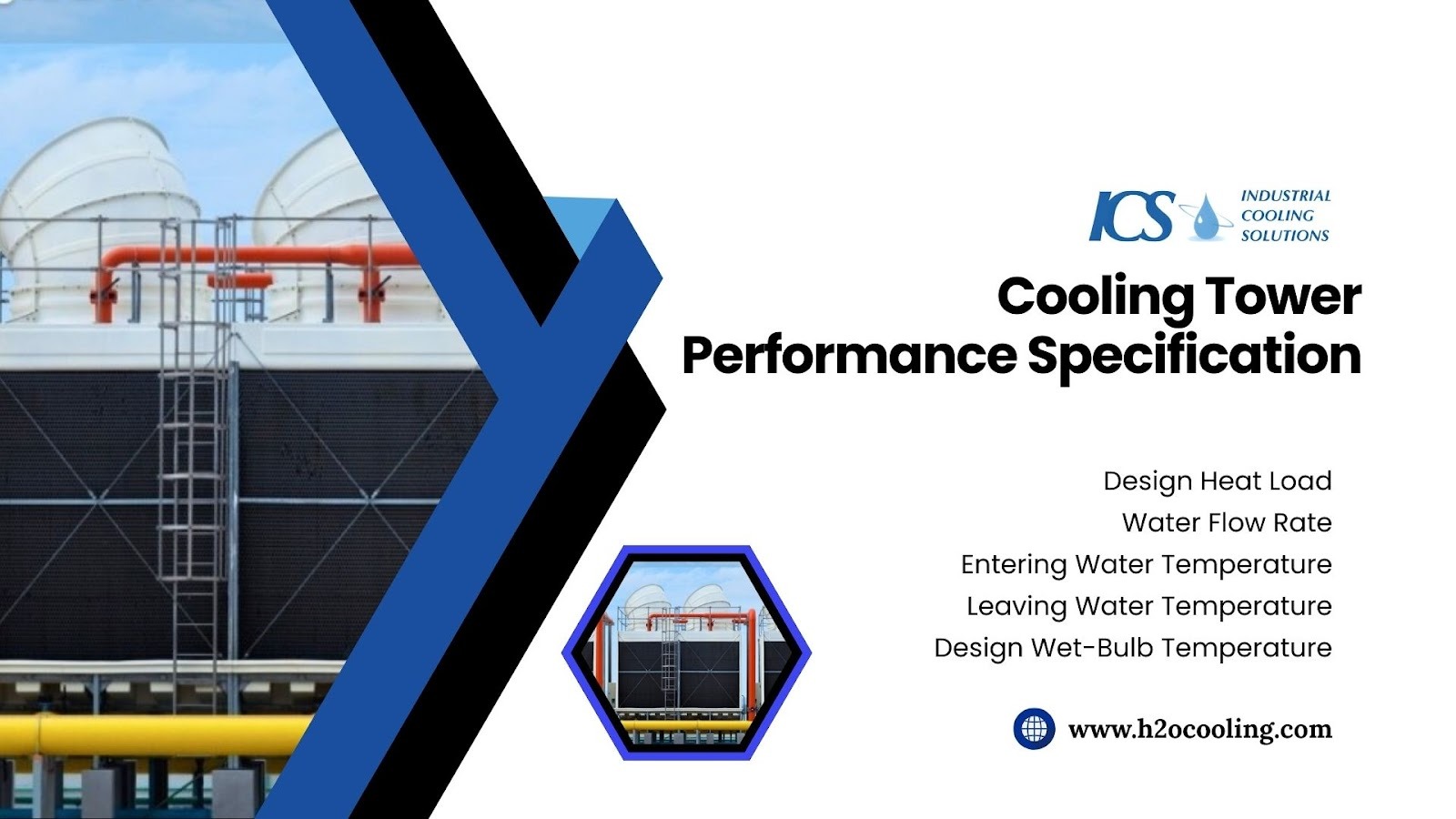
Cooling Tower Performance Specification
When creating a performance specification for vendors, clarity is paramount to ensure you receive competitive and compliant bids. You must clearly define the operating conditions and the expected thermal performance to avoid ambiguity during the procurement process.
Engineers should include the following specific data points in any robust specification document to ensure the manufacturer can size the unit correctly:
- Design Heat Load: The total amount of energy to be rejected (BTU/hr or kW).
- Water Flow Rate: The volume of water circulating through the system (GPM or m³/hr).
- Entering Water Temperature: The temperature of the hot water returning from the process.
- Leaving Water Temperature: The required cold water temperature needed by the equipment.
- Design Wet-Bulb Temperature: The worst-case ambient humidity and temperature condition.
Selecting Design Points (Practical Guidance)
Selecting the right design point is as much an art as it is a science, requiring a balance between theoretical physics and economic reality. Proper design point selection ensures that the cooling tower meets the facility's needs without overextending the budget.
Trade-Offs in Parameter Selection
Every design choice carries a consequence regarding size, energy use, or cost. Engineers must weigh the benefits of colder water against the penalties of larger equipment footprints and higher fan horsepower requirements.
Key trade-offs to consider when finalizing cooling tower design parameters include:
Approach vs. Size: Reducing the approach from 7°F to 5°F can increase tower size by 20% or more.
Range vs. Flow: Increasing the range allows for lower flow rates, which reduces pump energy but may require larger heat exchangers at the process end.
- Fan Power: Tighter design parameters often require higher airflow, leading to increased fan motor horsepower and operating costs.
Real-World Example Design Case
Let us look at a tangible example to clarify these concepts. Suppose you have a system requiring 1,000 GPM flow and a heat rejection load.
Given:
- Flow Rate: 1,000 GPM
- Hot Water Inlet: 95°F
- Cold Water Outlet Target: 85°F
- Design Wet Bulb: 78°F
Calculation:
Approach = 85°F - 78°F = 7°F
In this scenario, the cooling tower must cool 1,000 GPM by 10 degrees. The tower must achieve this while the ambient air allows for a theoretical minimum of 78°F. The 7°F approach indicates a standard, cost-effective tower size.
If the client demanded an 80°F cold water outlet, the approach would drop to 2°F, which is likely physically impossible or financially ruinous.
Effects of Approach & Range on Operating Efficiency
The selection of cooling tower design parameters has a direct downstream effect on the efficiency of the chillers or process equipment the tower serves. A lower approach temperature allows the tower to deliver colder water, which improves the heat transfer rate in condensers.
- Chiller Efficiency: Every degree the condensing water temperature drops significantly improves chiller efficiency.
- Energy Savings: Reducing the design approach from 7°F to 4°F can cut chiller compressor energy consumption by about 2% to 3%.
- Net Impact: Although the cooling tower fan might use slightly more power, the overall facility often sees substantial net energy savings.
Design Considerations for Different Cooling Tower Types
Different cooling tower configurations respond differently to changes in approach and range. Whether the system utilizes natural draft, induced draft, crossflow, or counterflow designs impacts how easily it can achieve tight design parameters.
When matching specific tower types to your design goals, consider how the airflow and water distribution interact:
- Counterflow Towers: Generally more efficient at achieving a close approach because the coldest air contacts the coldest water. These counterflow towers are compact and ideal for applications where space is limited. However, their design may require higher energy input for air movement.
- Crossflow Towers: Often have lower static pressure drops but may require more fill volume to achieve the same tight approach as a counterflow unit. They are easier to maintain due to their open layout, which allows for easier access to internal components. Crossflow towers are also well-suited for areas with low water quality.
- Natural Draft: Heavily dependent on the range and humidity; these are typically used only for very large heat loads where mechanical fans are impractical. Their reliance on natural airflow makes them highly energy-efficient, but they require significant space and are often associated with industrial-scale applications.
Water Loss, Evaporation, and Circulating Water Systems
Water loss is a design parameter in its own right, directly affecting makeup water sizing and chemical treatment cost across the circulating water loop. Evaporation is the primary mechanism a tower uses to reject heat, and evaporation loss runs roughly 1% of circulating flow per 10°F of range; on the 1,000 GPM example above, that is roughly 10 GPM lost to evaporation alone. It is not the only source, though: drift, the fine mist carried out with exhaust air, and blowdown, water deliberately discharged to control dissolved solids, both add to the total. A realistic water balance needs all three, or makeup sizing will run short.
Avoid These Common Cooling Tower Design Mistakes
Even experienced engineers can fall into traps when specifying cooling towers if they overlook local variables or system integration. Avoiding these common errors ensures the system operates reliably throughout its intended lifespan.
Review these frequent design pitfalls to ensure your cooling tower design parameters are robust and realistic:
- Ignoring Local Microclimates: Relying on regional weather data without accounting for local heat islands or recirculation from nearby equipment leads to an undersized tower.
- Unrealistic Approach Goals: Specifying an approach of 2°F or 3°F is often technically feasible but economically disastrous due to the massive tower size required.
- Flow Mismatch: Failing to verify that the actual pump flow matches the design flow can skew the range, altering the heat transfer dynamics.
- Improper Water Treatment: Overlooking proper water treatment can lead to scaling, corrosion, and biofouling, significantly reducing the tower's efficiency and lifespan.
- Neglecting Maintenance Needs: Designing a system without considering ease of maintenance can result in higher operational costs and downtime due to inaccessible or poorly designed components.
Conclusion
Mastering cooling tower design parameters starts with getting range and approach right for your actual heat load and site climate, not a generic catalog number. Engineers who balance approach against tower size, confirm real tower performance curves , and budget for total water loss end up with systems that hit their rated outlet water temperature year after year, whether specifying a new installation or re-evaluating an existing plant.
What is the difference between approach and range?
Range is the temperature drop between the hot water entering the tower and the cold water leaving it. Approach is the gap between that leaving cold water and the ambient wet-bulb temperature. Range reflects the heat load; approach reflects how close the tower gets to its physical cooling limit.
What is a good design approach value for industrial towers?
Most industrial applications target a design approach between 5°F and 8°F (2.8°C to 4.4°C). This balances capital cost against thermal performance, since going tighter than 5°F drives tower size up sharply for diminishing temperature gains.
How does wet bulb affect design parameters?
Wet-bulb temperature sets the absolute floor for evaporative cooling. A higher wet bulb forces the designer to accept a warmer outlet water temperature or build a larger tower to hold the same cold water target.
Why do low approach towers cost more?
As approach shrinks, the temperature difference driving heat transfer shrinks with it, so the tower needs significantly more fill surface area and airflow to remove the remaining heat, which drives up size and cost.
How much water does a cooling tower lose to evaporation?
Evaporation loss typically runs close to 1% of circulating flow for every 10°F of range, though drift and blowdown add to total water loss on top of that. Actual numbers shift with cycles of concentration and local humidity.
What is a cooling tower ton?
A cooling tower ton equals roughly 15,000 BTU/hr of heat rejection at standard conditions, slightly higher than a 12,000 BTU/hr refrigeration ton because it also accounts for compressor heat added to the load.
Request a quote
Request a quote. The RFQ form is the only conversion path on this estate: no telephone number, email address or live-chat widget appears on any page.
Related pages
- Cooling Tower Heat Load Calculation: The 2026 Guide
- Cooling Tower Ton Calculation: Master Precision Sizing
- Mastering Cooling Tower Performance Curves
- Technical articles